
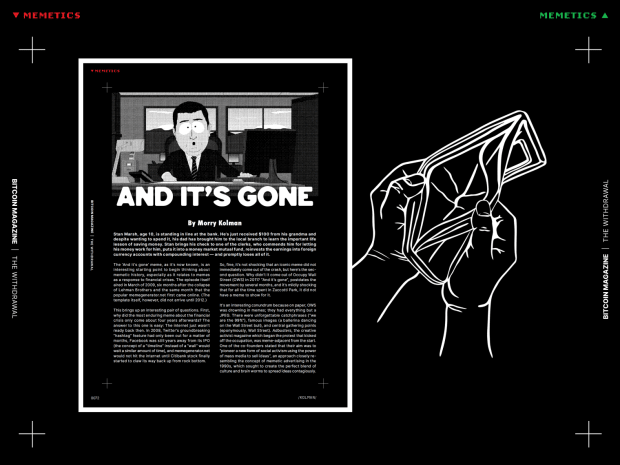
This article is featured in Bitcoin Magazine’s “The Withdrawal Issue”. Click here to subscribe now.
A PDF pamphlet of this article is available for download.
Stan Marsh, age 10, is standing in line at the bank. He’s just received $100 from his grandma and despite wanting to spend it, his dad has brought him to the local branch to learn the important life lesson of saving money. Stan brings his check to one of the clerks, who commends him for letting his money work for him, puts it into a money market mutual fund, reinvests the earnings into foreign currency accounts with compounding interest — and promptly loses all of it.
The “And it’s gone” meme, as it’s now known, is an interesting starting point to begin thinking about memetic history, especially as it relates to memes as a response to financial crises. The episode itself aired in March of 2009, six months after the collapse of Lehman Brothers and the same month that the popular memegenerator.net first came online. (The template itself, however, did not arrive until 2012.)
This brings up an interesting pair of questions. First, why did the most enduring meme about the financial crisis only come about four years afterwards? The answer to this one is easy: The internet just wasn’t ready back then. In 2008, Twitter’s groundbreaking “hashtag” feature had only been out for a matter of months, Facebook was still years away from its IPO (the concept of a “timeline” instead of a “wall” would wait a similar amount of time), and memegenerator.net would not hit the internet until Citibank stock finally started to claw its way back up from rock bottom.
So, fine, it’s not shocking that an iconic meme did not immediately come out of the crash, but here’s the second question. Why didn’t it come out of Occupy Wall Street (OWS) in 2011? “And it’s gone” postdates the movement by several months, and it’s mildly shocking that for all the time spent in Zuccotti Park, it did not have a meme to show for it.
It’s an interesting conundrum because on paper, OWS was drowning in memes; they had everything but a JPEG. There were unforgettable catchphrases (“we are the 99%”), famous images (a ballerina dancing on the Wall Street bull), and central gathering points (eponymously, Wall Street). Adbusters, the creative activist magazine which began the protest that kicked off the occupation, was meme-adjacent from the start. One of the co-founders stated that their aim was to “pioneer a new form of social activism using the power of mass media to sell ideas”, an approach closely resembling the concept of memetic advertising in the 1990s, which sought to create the perfect blend of culture and brain worms to spread ideas contagiously.
OWS also exhibited memetic tendencies in the way it carried its business. The “People’s Mic” is one such example. Denied a permit to use a microphone, the organizers used a unique form of communication that used the protestors to amplify their messaging, rather than a speaker. One person would stand in the middle of a crowd and give their speech broken up into soundbites of a few words at a time, the people closest to them would repeat it louder for those behind them, and so on. If the People’s Mic was a meme-like exercise in repetitive speech, the public services they ran were a performance of committing to the bit. Take the library for example. They set up makeshift shelving structures, developed lending systems, and in the middle of all the mayhem managed to set up a passable operation. Of course, it didn’t work very well — a protest is not an ideal space for a library — but Stephen Duncombe, Professor of Media and Culture at NYU, notes that the OWS library was never intended to function in a traditional manner. A large part of OWS protest tactic was to, in his words, “perform” what they were demanding; in the case of the library, a selfless devotion to the commons. In the case of the people’s mic — similarly plagued by clear logistical issues (like seven-word shouts being a bottleneck on communication) — a decentralized, cooperative public sphere. The world is watching, so if you’re not going to do it for the vine, at least do it for the people at home watching through the TV cameras.
But again, all this — the 99% chants, the spectacles of anarchist community, media attention 24/7, and still no memes…? It would be too far to say that OWS was a failure. Their strategies have left some lasting imagery and continued relevance in the way that similar movements, like the Tea Party, have not. That said, their approach is illustrative of the immaturity surrounding internet communications and viral media strategy in the early 2010s. There was little thought given to how to activate others beyond “come here or start your own there” and no attempt to cohere a message beyond complete inclusion (“we are the 99%, yes you, and you too”). Radical? Yes. Contentless? Also yes. OWS had a lot of virality, and it was all empty.
To be fair, this was only the earliest iteration in what would be a decade defined by the internet realizing itself. The next year, just a month before “And it’s gone” came out, Kony 2012 ripped through the internet becoming the first video to reach 1 million likes on YouTube and bringing about a public discussion on what viral movements meant in the face of lazy “clicktivism”. The next year, the Harlem Shake proved that with sufficient viral momentum, it was easy to get hundreds of people to show up and make an offline event happen for an online trend. As the years went on, the internet only got more and more proof, taught via an endless stream of examples, of just how effective it could be en masse. A British research ship was named Boaty McBoatface and Trump was elected President of the United States in the same year — both after significant online pushes behind their candidacy. Coincidence, or testament to the awakening power of the online swarm?
Fast-forward to 2020, where two men face each other, one of them in tears. Hair high and tight, sporting a black and yellow bowtie, the despondent man lashes out against the other’s choice of monetary policy. “No!” He says, “You can’t artificially inflate the economy by creating money to fight an economic downturn!” His opponent, an old man, stares back silently, hand hovering over a button connected to a large machine. “You can’t just change market signals by using monetary policy”, he continues, increasingly distraught. “You are distorting the natural rate of interest!” The old man takes a sage-like breath and, with all the force of a butterfly’s wing, presses the button. “Haha”, he says calmly, words cloaked in koan as the machine hums to life, green notes shooting around the room, “money printer go brrr”.
This is a more evolved meme, one that is more than just something ripped from a South Park episode; “money printer go brrr” has a number of markers of progress compared to “And it’s gone”. First of all, its characters are two Wojacks, an evolution from and improvement upon, the rage comic figures of old; much more template-like and customizable than having completely different characters for individual emotions. Second, the writing is no longer top-text/bottom-text, a format that at this point dates almost any meme. Since the days of classic meme generators like QuickMeme and the like, there has been an explosion in the breadth of memes, both in styles and all the possible ways to make them. Creators are no longer going to QuickMeme or posting their content on imgur. These days they’re cultured and use apps like Mematic or pirated copies of Photoshop. Lastly, it has an AnCap (anarcho-capitalist) flag as the complainant’s bowtie, insinuating via its popularity that there is enough latent political literacy among posters that they can identify a rather niche political identity and lampoon it and that, in general, there is now a much greater visual vocabulary for memes and politics than a decade ago.
The biggest change, however, might be the non-visual one. This meme did not have to wait three years to get made. “Money printer go brrr” came out in tandem with the growing COVID-19 economic anxiety and developed in tandem with it. No longer was there a near half-decade gap between financial collapse and responding memes. In the decade since OWS, the lag time between memes and politics had shrunk from eras to hours.
For the financial crisis identified in “money printer go brrr”, instead of coming after the resulting organized political rebellion, the memes actually preceded it. By the time the pot boiled over and there was a mass unloading of grievance directed at financial institutions, it almost seemed like the logic of OWS had been inverted; instead of using memetic tactics towards political goals, the main upheaval of the financial turmoil of COVID-19, WallStreetBets (WSB), used political tactics towards its memetic ones — politics, in other words, became a very engaging means of shitposting.
Many would be loath to call WSB mature. After all, the subreddit describes itself as “if 4chan found a Bloomberg terminal”. Nevertheless, its takedown of Citadel and Robinhood by driving the price of GameStop and AMC through the roof shows many improvements upon and remixings of OWS tactics. First, instead of approaching the decentralization of messaging and power as a dynamic of complete unique inclusion (the OWS philosophy that anybody can demand anything), WSB took it as a dynamic of collective responsibility and expression (post however you want, but in service of holding the bag). Second, WSB leveled up the OWS ethos of performing the type of change you want to see in the world by choosing a medium of expression that actually affected their targets. Occupy kneecapped itself as a movement when it took a model from the Arab Spring struggles against state violence to a financial battlefield. While it makes sense to occupy an area as a resistance to a state because a state is defined by its control of an area, it makes no sense to occupy Wall Street because the forces of fractional reserve banking and globalization do not have a physical presence in the same way. They do, however, have economic and technological presence, which the average redditor can interact with via a handy iPhone app. By choreographing stock buys and orchestrating short squeezes, WSB not only gave the world a show of what it looked like when tens of thousands of people agreed to say “screw the hedge funds”, but they did it in a way that was participatory and accessible to anyone who wanted skin in the game. Sure, there was a profit motive when the battle was in their favor, but in the same way that OWS’ library was meant to illustrate a point more than to be a long-term institution, WSB was happy to play chicken with firms as their portfolios dwindled closer and closer to zero just to show they could. In their words, “we can stay retarded longer than you can stay solvent”.
From the delayed response of “And it’s gone” and the internet ineffectuality of Occupy Wall Street to the swift reactions of “money printer go brrr” and the larger-than-life online experience of WallStreetBets, the online swarm has learned to harness its collective power in ways that both entertain and enact change. While Occupy Wall Street may have been a harbinger of this potential, it was ultimately a movement that struggled to find its footing in the digital age. Today, however, we see a new generation of activists and meme lords who have successfully blurred the lines between politics and posting, meaning and memeing. Whether this is for better or worse is a question for the next decade, but at least this one already has the humor down.
This article is featured in Bitcoin Magazine’s “The Withdrawal Issue”. Click here to subscribe now.
A PDF pamphlet of this article is available for download.
This is a guest post by Morry Kolman. Opinions expressed are entirely their own and do not necessarily reflect those of BTC Inc or Bitcoin Magazine.
Credit: Source link