

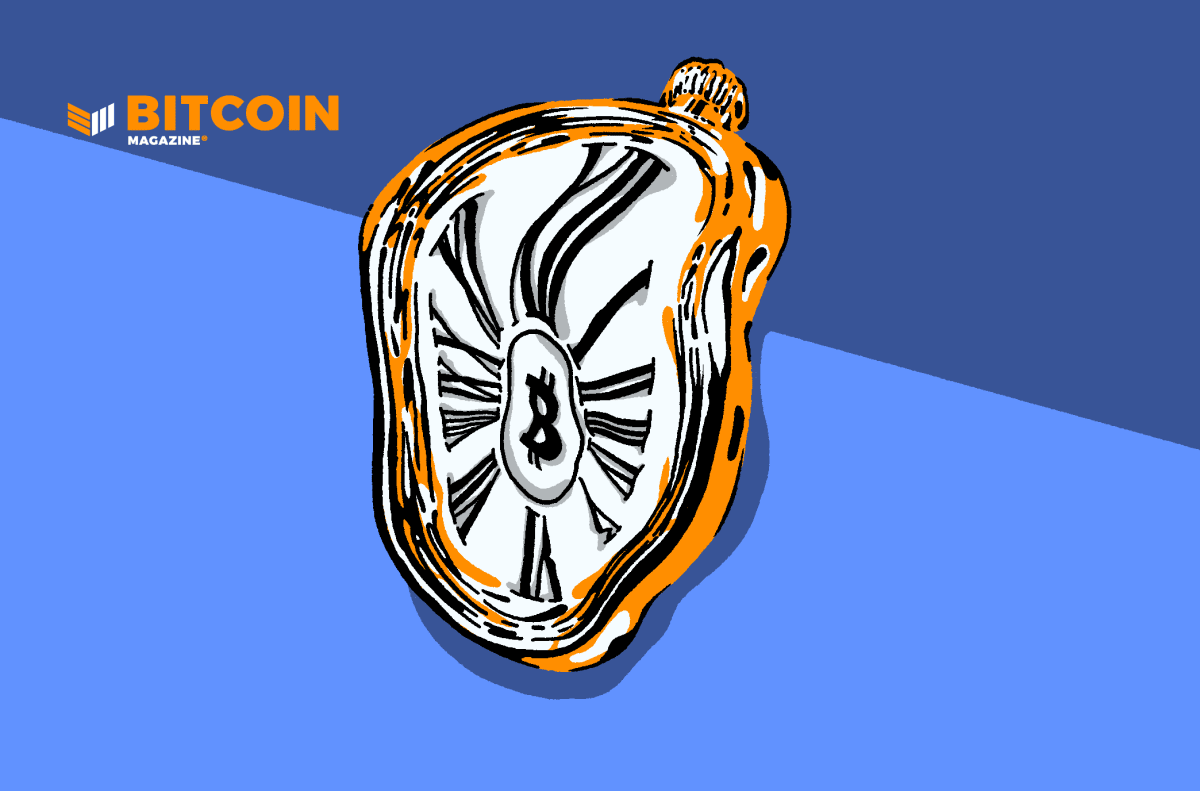
This is an opinion editorial by Dr. Riste Simnjanovski, a tenured professor of public administration with California Baptist University.


Vinyl records should be obsolete, however Jack White, Ben Blackwell and Ben Swank’s Third Man Records continue to press on, literally.
Dedicated media channels featuring content creators such as Teddy Baldassarre, a YouTuber who mostly reviews analog wrist watches, likewise, shouldn’t be approaching 1 million subscribers.
White, Baldassarre and many others continue to rage against a digitized world with grace and cult followings.
Bitcoin, while being a digitized software protocol, implements one of the most elegant solutions to security in this same vein — an offline, analog, seed phrase. In fact, many seed phrases are stored on pieces of paper, carved and/or stamped into pieces of metal or are typewritten… with vintage typewriters.
Even Bitcoin Magazine, while having a massive online presence, sells out of their physical publications.
The analog aspect of humanity isn’t a trend — analog defines us.
For many, something deeper occurs when they place a record onto a player. The act of moving a physical arm, which houses a delicate needle onto pressed vinyl, and then hearing the scratches, pops and subtle noises of the system at work is not listening, it’s feeling.
Similarly, the physical task of manually winding a watch involves touch. The act of twisting the crown provides feedback to not only the fingers, but the ears as well. Some even might argue, the heart is engaged. In regard to wearing an automatic watch, some owners can “feel” the rotor within the micro-mechanical system as it spins on their wrist.
Improbable Correlations, Experiments And Errors
The earliest mechanical (automatic) watch dates back to the early 1500s. A spherical timepiece that, when manually wound, ran for upwards of 16 hours.
The piece, which was reported to have been created by horologist Peter Henlein (a German clockmaker) for Philipp Melanchthon (the patron), was accurate to the nearest half hour.
Within 100 years, Galileo Galilei was tinkering with the concept of “pendulum clocks”; however, while Galileo’s sketches illustrated a profound interest in the potential of creating a pendulum clock, he did not construct one before his death.
The development of the first pendulum clock is credited to horologist Christiaan Huygens in the mid-1600s. Huygens’ earlier works purported accuracy of approximately one minute per day, but iterations pushed the clock-maker to error’s less than 10 seconds per day. Fast forward another 75 years or so, and clockmakers had refined the craft to an accuracy of plus or minus 1 second per day into the 1700s.
A fun experiment for readers if you want to understand Huygens’ physics: Create your own crude pendulum by tethering a weight to a string. Once the weight is hanging freely, grab the string in one hand and then use the other hand to pull the weight to one side, then let go.
You’ll notice the weight swing from one side to another… not very fascinating, right? But then, grab the weight and pull it from a higher distance and let go. Repeat from a lower distance.
What you’ll find is exactly what Huygens theorized and then proved; that the stored potential energy of the weights plays no role in how fast the pendulum swings — the time the pendulum takes to pass through the center is constant; no matter how far you drop the pendulum from.
The only way to adjust the speed of the pendulum is to either increase or decrease the actual length of the string; a longer string length equates to a slower pendulum rate (pulse); and a shorter length, thus results in a faster pulse or tick as the weight swings back and forth.
This, for all intents and purposes, is how mechanical watches are adjusted, except without a string, a tiny piece of metal (a spring) is wound. If a watch is running slow or fast, adjustments are made within the system. Not much has changed in the past 150 years or so. It’s beautiful because it’s simple.
I correlate the accuracy errors of mechanical timepieces to my Bitcoin discovery phase. Initially, I believed that every 10 minutes, a new Bitcoin block was created; however, as I surrounded myself with more experienced community members, technical personnel and cypherpunks, I learned that block times vary, or “oscillate,” between a few seconds in deviation to a few days in some cases. The protocol adjusts the length of the pendulum string automatically based on the needs of the network.
The mechanical aspects of time deviation that Satoshi Nakamoto coded into Bitcoin, unlike watchmaking, are features, not bugs.
Tick Tock, Next Clock
High horology, also known as the more precise, meticulous and highly-time-consuming task of creating bespoke and, in many instances, the most exceptionally accurate mechanical timepieces known to man, often turn a blind eye toward quartz, digital, solar or hybrid movements.
While many may not realize this, a typical quartz Timex or Casio is more accurate than many high-end mechanical watches. Additionally, some watch connoisseurs do not regard many of the “expensive” brands as constituting “high horology” simply because of their brand names. The devil is in the details.
Collectors might, however, consider a bespoke offering from a watchmaker that they may have never heard of, assuming that the horologist created something remarkable, such as the quad-layer, guillochéd Resurgence timepiece that Joshua Shapiro has prototyped in Southern California.
The irony is that many watch collectors typically also have a $40 to $100 Casio G-Shock (or equivalent) wristwatch in their collections. There are various reasons why, but in truth, different tasks require different tools.
Regarding Bitcoin, the tool of BTC awaits tasks, layers and adoption. Bitcoin is both high horology and a $40 Casio. The application adapts based on the user and the network; but most significantly, upon the developers who dedicate their lives to bettering the network.
Jewels
When considering the number of gears, wheels, pinions, springs, etc., in a mechanical watch movement, a lot of friction is generated between the micro-metallic components, not unlike the friction caused by some within the BTC community.
As such, jewels in a mechanical watch can be more commonly referred to as “bearings.” As such, a jewel does not represent “jewelry,” but rather a precise gem-bearing implemented to reduce friction.
If you own a mechanical, automatic or any variation of a modern self-winding watch, odds are, there is a “jewel” number on the back of the timepiece.
Quartz timepieces may not have a single jewel in their mechanism, while others may have a handful.
Implementing a battery, generators and capacitors into quartz movements has reduced or removed the need for traditional “jeweling.”
Most mechanical watches have 17 jewels, while more complex timepieces implement more.
Initially, diamonds, rubies and sapphires were implemented as bearings in these complex timepieces. Today, even the most well-known watchmakers utilize synthetic sapphires or rubies.
In Bitcoin, horology matters.
Whether one has caught the bug of watch collecting or has zero knowledge of that space is irrelevant to the field of horology; the space drives forward without them. The mechanics of automatic watches haven’t changed in hundreds of years and, in truth, perhaps this is why the field is so endearing.
Bitcoin is on the same trajectory.
While many believe Bitcoin is too complex to understand, these same critics use other technologies daily and, ironically, could never articulate how the technology they use every day actually functions.
Some members of the same community view Bitcoin as archaic technology; everything revolves around perspective.
If you asked most of the population how a mechanical watch “tells time,” could they tell you? Even many watch collectors could not identify all of the parts in a movement, and that’s okay.
Adoption is adoption.
With or without them, the Bitcoin protocol ticks on in a similar fashion.
My mechanical watch may sit idly by; however, once I pick it up and put it on my wrist, the second hand begins to sweep, and the inner workings spring back to life.
Bitcoin in cold storage is akin to an automatic watch waiting to be worn.
Within the Bitcoin community, there are friction points, not within the software per se, but within the community itself.
Jewels in the Bitcoin community might exemplify friction-reducing individuals, programmers, node operators and the like, who are often downplayed at conferences, online and in the real world.
Most recently, some programmers have attempted to introduce friction into the mechanics of the Bitcoin protocol.
The friction reduction aspects (jewels) of the Bitcoin community are under-appreciated but play a critical role in the protocol.
I encourage the cypherpunk community to be on guard for continued attacks in an attempt to create friction within the protocol and to be prepared with additional jewels in hand, ready for deployment.
In previous articles and a book, I hinted at the quiet Bitcoin community (QBCs) and its significance; perhaps I should refer to them as “jewels” in our protocol moving forward.
Stay strong and continue to do good work — you are appreciated.
Author’s note: Special thanks to Bitcoin Magazine, Peter Chawaga and company; to Third Man Records, especially Jack White and his crew; to Drs. Minesinger, Dunbar, Sturz, George and Ardito for editing and feedback; and finally the team working with Teddy Baldassarre — I’m looking at you John Stursa, thanks for the support.
This is a guest post by Dr. Riste Simnjanovski. Opinions expressed are entirely their own and do not necessarily reflect those of BTC Inc or Bitcoin Magazine.
Credit: Source link