
What’s modularity anyway?
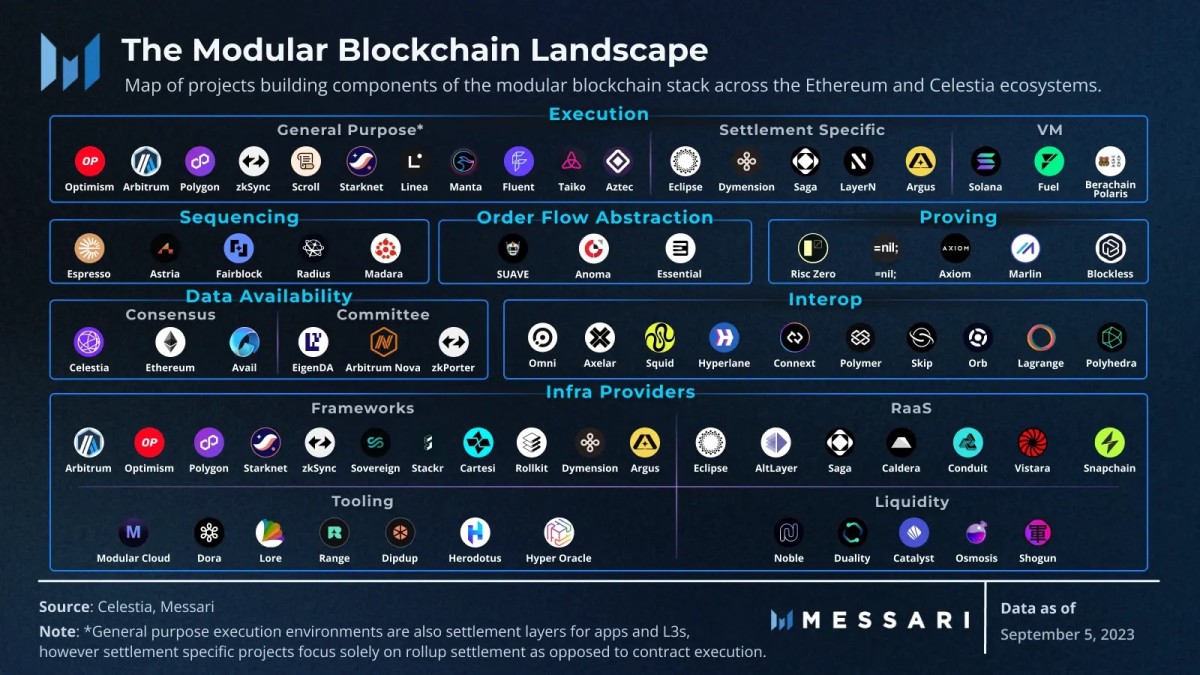
Modularity is the result of a curious experiment playing out in Ethereum as a reaction to the poor scaling properties of blockchains. To address this bottleneck, developers have taken the radical approach of auctioning off core functions of the main chain to… other blockchains.
Centered around rollup technology, this modular transformation has completely redefined how products and services are built on top of Ethereum. Breaking apart every element of the stack allows different architectures to be designed according to their use cases. Understandably this has led to a proliferation of… blockchains.


I kid you not. Everyone is getting hilariously rich selling blockchains, again.
While each new consensus protocol offers novel and interesting scaling opportunities, they also introduce a weird coordination problem. If users become dispersed across different networks, how is the economy made more efficient? How can we synchronize everyone across this distribution? Maybe one more… blockchain?
It’s turtles all the way down.
This fragmentation of the ecosystem has had a few obvious consequences. For one, users are siloed and trapped between intermediaries. While rollups have compelling trust-minimization properties, the inefficiency created by the transfer in and out of those systems creates unreasonable costs for users. It also exposes them to more risky options like bridges and centralized services.
For developers, the absence of interoperability across platforms creates friction and fosters a competitive rather than collaborative environment. Every other day a new protocol is created for new and existing teams to compete over with yet another copy of the same applications. In many cases, teams are opting to “bet on themselves”, spinning off into their own ecosystem (read: blockchain). It’s crucial to emphasize the appeal of this model, which allows for the customization and optimization of diverse components for each application. This flexible architecture empowers anyone to contribute their unique frameworks and inspire new designs. The possibilities are endless!
Unfortunately, those incentives have resulted in the fragmentation of the network effect. If nothing that’s built fits together, users will consolidate towards only a handful of competing networks. As a result, economic activity becomes concentrated into fewer permissioned systems.
This brand of modularity has brought people further from the goal when it shouldn’t. Using different interfaces to interact with the consensus protocol is a perfectly valid idea. However, Ethereum’s strategy proves problematic; it regards interoperability more as an optional feature than a foundational design principle. As long as Ethereum continues to pursue scalability by multiplying blockchains, the debate will persist, providing ample opportunities for competitors to exploit these divisions and encourage discord. Divide and conquer.
Bitcoin’s opportunity
On Bitcoin, a different architecture is emerging that favors a fundamentally different design. Using Lightning as the interoperability backbone, developers are slowly coalescing towards a technology stack much closer to Bitcoin’s peer-to-peer model.
Rather than attempt to replicate global shared states, protocols like Cashu or Fedimint are optimizing for local and permissionless interactions. Financial services can now be deployed across different economic hubs and remain connected through the Lightning Network.
Liquidity providers, atomic bridges, and ecash mints. A novel financial network all sharing the same settlement layer.
Nostr’s arrival provides the social abstraction that ties it all together. A social network based on similar principles as Bitcoin, it provides a simple set of rules engineered to maximize interoperability. By avoiding being prescriptive about the functions it enables, Nostr is unleashing a Cambrian explosion of open innovation.
Today, different projects are beginning to explore ways to facilitate Bitcoin commerce by making Nostr a native component of the Bitcoin user experience. The public key infrastructure underlying the protocol is a natural match for wallets and other payment applications, allowing them to communicate with each other and securely exchange messages. This communication layer can connect users with others and various services made available through the network. Standards like Nostr Wallet Connect are creating new opportunities for Bitcoin applications to interface with Nostr’s growing ecosystem.
A case study
Projects like Mutiny perfectly embody the differences in this Bitcoin modular vision. Users can simultaneously connect with services like Nostr Relays, Fedimint federations, and Lightning Service Providers (LSPs). Each of these grants access to a growing number of features and applications. Using Nostr as a discovery service, we are empowered to leverage our social network to identify and natively access applications and services endorsed by our peers. This web-of-trust introduces an interesting alternative to so-called trustless systems. Participants can begin relying on market incentives to engage in more efficient exchanges that aren’t encumbered by the tradeoffs required of more decentralized systems.
Eventually, marketplaces will emerge for liquidity providers, ecash mints, lenders, and coinjoin coordinators to advertise their services through Nostr. Decentralized order books projects Civkit could seamlessly integrate with Mutiny and allow users to engage in peer-to-peer trades. Every integration is designed around permissionless participation so that users can maintain full sovereignty over their interactions.
Platforms vs. protocols
Bitcoin’s modular story is not without its own risks. Fundamental pieces of the puzzle such as LSPs involve significant capital requirements that will create economies of scale between competing providers. The growth of ecash mints may be hindered by regulatory concerns and operator fraud. Nostr relays have already shown centralization tendencies and it remains unclear how the network topology will play out.
The success of this approach rests on market optionality and it is essential that the barriers to entry into these businesses remain low. A number of different efforts are being deployed to that end. For example, multiple Lightning companies are currently collaborating on a specification that would allow any market actors to implement their own LSP.
It’s probably too early to forecast how any of those architectures and protocols will evolve. As both worlds continue to collide, it’s likely that rollups find their place within the Bitcoin ecosystem. Application specific designs such as exchange rollups or zkCoins do not require global state and could perhaps be made to be interoperable with Lightning.
The tension between both methods is somewhat reminiscent of the early days of the internet. Commercial interest may favor platforms that allow them to capture portions of the network effect in order to monetize it. It could take longer for more open and permissionless protocols to truly get off the ground. The internet provides a cautionary tale with regards to the consolidation of services and applications into gatekeeping walled gardens. Hopefully, the current Bitcoin development path resolves into a future that prioritizes interoperability and permissionless access over financial silos.
Credit: Source link